
Eid Al-Adha is not only a religious festival but also a big observation of social manners, people’s expenses, feelings and expressions. For university students, who depend on family or their own earnings, financial requirements and other observations during Eid may significantly affect their participation and overall experiences of the festival.
Against this backdrop, a survey was conducted in May 2026 among Muslim students of the University of Dhaka in anticipation of Eid Al-Adha 2026. A total of 81 students participated, representing 36 academic departments across the university. The survey was conducted anonymously, with no personally identifiable information collected. Its primary objective was to understand students’ lived financial experiences during Eid, rather than to evaluate or stigmatize any individual or group.
The questionnaire consisted of 12 structured questions covering key areas including department and academic year, total household income, sources of earning, estimated Qurbani and other Eid expenses budget, financial challenges, the impact of economic pressure on Eid participation, access to external help, willingness to support others, and personal experiences.
This study aims to shed light on the intersection of economic reality and religious celebration among university students, highlighting how financial conditions influence participation in Eid Al-Adha. This survey is basically to gather and acknowledge students' financial condition and expressions to most common insights. The following section presents the key findings of the survey:
Household Income & Economic Dependency
The vast majority of respondents, nearly 75% of the respondents, rely entirely on family structures (primarily fathers, siblings, or multi-earner households) to cover basic monthly expenses. Total monthly household incomes in this bracket range widely from 35,000 BDT to upwards of 85,000 BDT.
A notable quarter of the student population operates as self-dependent, balancing personal income streams alongside their academic commitments to sustain themselves and contribute to their households.
Eid Al-Adha Budgetary Allocations
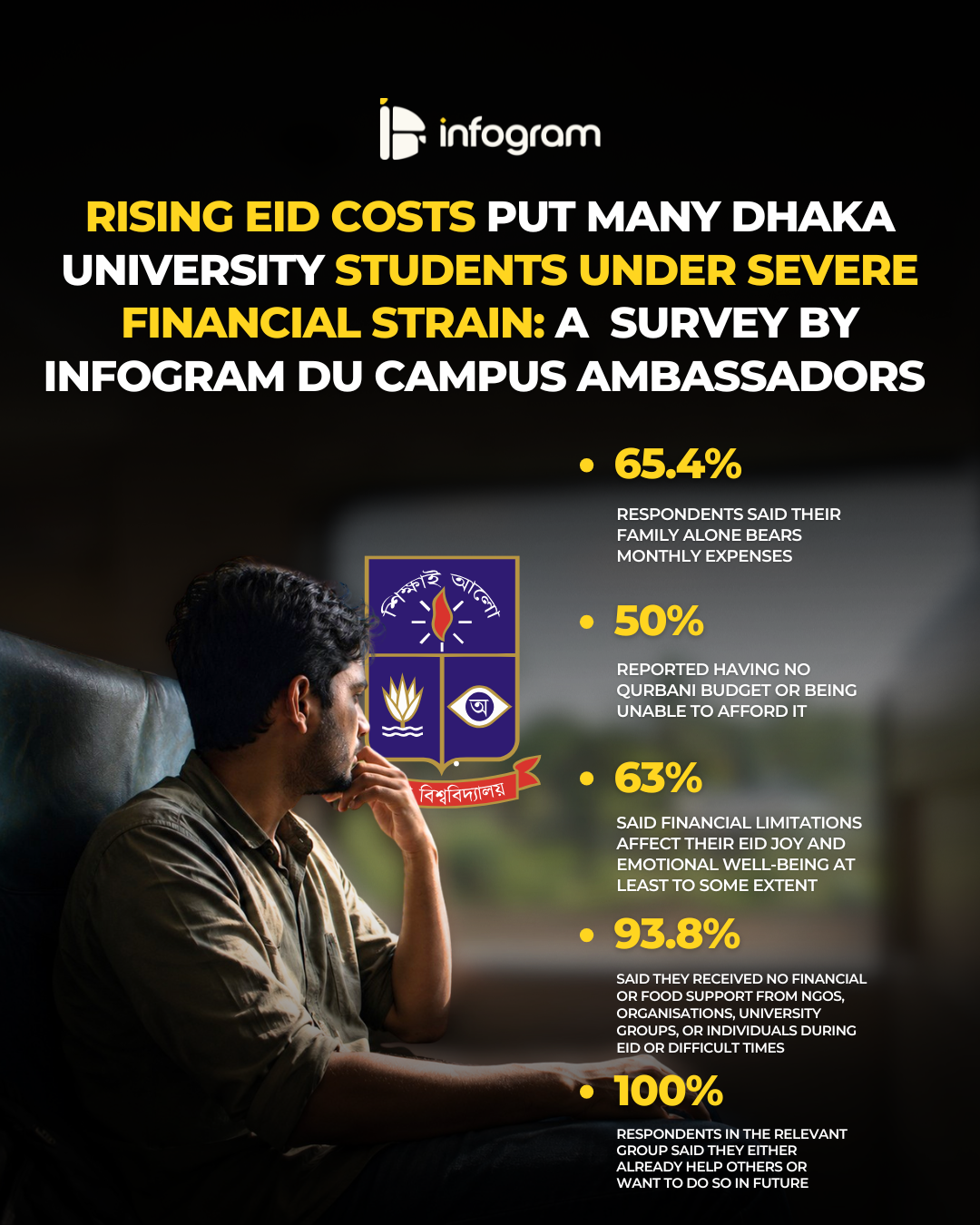
50% of respondents stated their family has a dedicated budget for Qurbani (ranging from 30,000 BDT to 50,000 BDT or higher), while the remaining 50% reported having "no budget" or being unable to participate in Qurbani due to financial constraints.
For other Eid costs like clothing, gifts, travel, and outings, the median budget is 3,000 BDT, with a range spanning from near zero to 100,000 BDT. This suggests that while many students can manage modest personal Eid expenses, the larger obligation of Qurbani remains financially out of reach for the majority.
Biggest Challenges
At least 44% of respondents cited money shortage, affordability, or financial pressure as their primary challenge during Eid. Challenges such as price hikes, inability to afford clothes or gifts, and fund shortages were frequently mentioned. Some students also mentioned academic pressure and the inability to fully enjoy the holiday due to personal or financial stress. Only a small number of about 5% reported facing no challenge at all. While 32.1% stated that financial limitations negatively affect their Eid joy and emotional well-being.
External Financial Support
The study further found that very few students receive external support during difficult times. A striking 95% (76 respondents) have received no financial or food assistance from any NGO, university group, or individual during Eid or difficult times. Only 5% reported having received support, primarily from relatives and friends, with one case citing an NGO or charity organisation.
Willingness to Help Others
Despite financial struggles, the responses reflected a strong sense of social responsibility and empathy among students. 71 respondents expressed a desire to help others during Eid Al-Adha in the future, if they become financially stable, while some respondents mentioned that they already help others according to their ability. This reflects a strong underlying spirit of giving regardless of personal financial constraints.
Several participants stated that the spiritual importance of Eid is greater than material spending, while others felt disappointed due to financial and academic pressures. These responses reflect the connection between religion, emotion, culture, and economic reality in students’ lives.
This survey examined the financial reality of Muslim students at University of Dhaka as they approach Eid Al-Adha 2026, an occasion that carries both deep religious significance and considerable economic demand. The central theme that emerges is a structural mismatch between the financial capacity of students and the costs associated with observing Eid, particularly Qurbani.
The core theme of this study is the direct translation of macroeconomic strain into psychological and ritualistic vulnerability among public university students. It challenges the assumption that university student demographics experience national celebrations uniformly. Instead, it exposes a deep economic bifurcation where a major religious festival like Eid Al-Adha transitions from a shared communal joy into a polarizing stressor, highlighting a divide between those who can afford the baseline traditions of the festival and those who are structurally excluded by cost.
This dataset is critical for academic and administrative policymakers. While university students are conventionally viewed through the lens of future intellectual capital, this study exposes their immediate, real-time vulnerabilities. It captures the hidden friction points such as the soaring costs of intra-country holiday travel and religious obligations that directly impact a student's mental health, dignity, and academic peace of mind.
Based on the survey several measures or recommendations can be considered such as:
- University-level student welfare support: To ensure Eid assistance funds, emergency financial support schemes, subsidized funding, and other financial aid mechanisms for students.
- Organisation-based support: Student organisations, NGOs, and charitable organisations can contribute to supporting financially vulnerable students during Eid-ul-Adha.
- Awareness and accessibility of existing support: Improve awareness and accessibility of available support provided by individuals, organisations, peers, or relevant institutions.
- Reduction of travel cost and Eid-related expenses: Initiatives by government, university, or organisations to reduce travel costs, and provide hall residency benefits, and small Eid-related support facilities.
- Development of peer support networks: Encourage structured peer-to-peer support systems among students to promote mutual assistance.
- Encouraging minimalist consumption practices: Promote awareness among students to prioritize essential expenses and reduce unnecessary Eid-related spending.
- Promotion of low-cost Eid participation options: Encourage affordable and practical ways of celebrating Eid to reduce financial pressure on students.
- Emotional support enhancement: Strengthen emotional and psychological support systems to help students manage stress related to financial constraints during Eid.
The overall outcome points toward a clear gap in support of infrastructure. University welfare systems, student organizations, and charitable bodies could meaningfully intervene whether through subsidized Qurbani programmes, Eid welfare funds, or coordinated food and gift distribution. The strong stated willingness of students to contribute to others (89% either already help or intend to) also suggests that a peer-to-peer support mechanism, if structured and facilitated, could have real impact. Addressing this gap would affirm that student welfare extends beyond academic support to encompass the broader human and religious dimensions of student life.
This report was jointly prepared by MST. Homayra Ashraf Orny and Farhana Maliha Chowdhury, both students of the Department of Printing and Publication Studies, University of Dhaka.